I remember when I first saw Doctor Who, the TV Movie. I
was fourteen years old, recently immersed in fandom, soon to go to my
first big convention, still heartbroken at the death of Jon Pertwee, and
with little time for anything so mundane as girls and alcohol (oh for
the days… so much cheaper…) It was Thursday the 23rd of May, 1996, the
day after the video release. I went to the bookshop after school, bought
the novel and the video, scurried home and watched ninety minutes of the
finest Doctor Who in seven years unfold, in a room quarantined from the
rest of my family, without lights and without blinking.
I remember the stunning pre-credits sequence, not caring that there were
now production credits at the beginning and no individual story title
(oddly enough, because I might well have done. I was that sort of
child).
The story certainly moved. First impressions were gobsmacking - the
vortex with it’s barrelling asteroids, the brassy arrangement of the
theme, Sylvester McCoy, the TARDIS, the console. Doubts that this was
some spoilt bastard offspring of the show I loved vanished with a pop.
Doctor Who was back, and about bloody time! Upsets were fleeting and
unaffecting. I remember noticing straight away the jarring editing of
the gun-fight, and not being terribly keen on the hospital scenes, (I’m
not terribly keen on being in hospitals) but my interest soon picked up
again. I remember the stunning adrenaline rush thereafter, as McGann,
Ashbrook, Yee Jee Tso and Roberts shone, the wonderful dialogue, and the
assured, imaginative direction. The kisses didn’t annoy me at all - all
fairly innocent and justified. The half-human bumph would later piss me
off something rotten for a while, but it was only a minor irritation at
the time.
The ending was a little unclear but the gist of it was there (they’d
already closed the eye, but it was too late to stop it’s effects, so
they had to bend time around the TARDIS - a temporal orbit - and thus
shunt everything back. Like Superman saving Lois Lane in one of the
films. See?). So I loved it.
And so a long weekend passed. The TV movie’s transmission, with one fell
swoop one bank holiday Monday in May, stopped the mockery at school for
being a Doctor Who fan. Rather like an Alan Turing who loved cheap
sci-fi instead of sums, I’d been unashamedly, obliviously ‘out’ as a Who
fan since I was young and often paid the price, until then. I’ll always
love it for that. Better - Insanely better -than any other Who we’d had
since Survival - Paradise of Death, The Ghosts of N-Space and the paltry
pseudo-Who, Dimensions In Time. (which bloody well is NOT canon!) it
gave immense hope for the future.
Five years later...
Well, there wasn’t a future. But never mind - the movie was beautiful,
witty, made with real care and a great ride. As a one-night stand, hard
to beat. I’ve relived the TV Movie quite a bit since that first time.
One bored, slightly drunken night, I thought about watching it with the
Children In Need 3D specs and, due to the constantly sweeping camera
work, it worked splendidly.
I’ve read the novel. Digested the utterly superb Regeneration book by
Gary Russell and Philip Segal. Bought the video. Watched the UK
transmission. Watched the unedited UK repeat. Read umpteen reviews, page
after page of fan review and analysis, and come to an odd conclusion.
This is a Doctor Who story that I love just as much for the same reasons
as I did when I was fourteen years old. The Nth Doctor and Regeneration
make us harshly aware of how utterly appalling the story could have been
- fathers, brothers, Gallifrey, redesigned Daleks… We got off so lightly
with the half-human malarkey, it’s untrue, and the Eye of Harmony being
in the TARDIS doesn’t really matter. It may be called ‘THE Eye’ in lazy
conversation, but then we always say “THE TARDIS” when we know there’s
more than one of them knocking around, so who’s to say AN Eye of Harmony
isn’t in every TARDIS? If the ending is vague, that doesn’t really
matter. Resurrection of The Daleks has no story at all and people love
that. The Jon Pertwee era WAS car/bike/hovercraft chases, and people
love that. Sometimes on a night, when your head’s a bit fuzzy, and
you’re having / remembering a wonderful time, it’s OK to give the
attractive girl nearby a spontaneous smacker on the lips. If she doesn’t
slap you, there’s nothing lost. With small supporting roles dotted here
and there, all played by very capable and memorable actors no less, the
four leads dominate the story.
What the story lacks in textual depth, it makes up for by well and truly
being about the Doctor, so that once we meet the eighth incarnation,
he’s rarely out of our sight, exactly how it should be. Paul McGann, the
reluctant Doctor behind the scenes, takes to the part like a duck to
water. With his enthusiastic return to the Big Finish soundstage, I have
a theory about why he was hesitant at the time to take on the role. I
wonder if he was afraid he might enjoy something seen by many as… well,
childish. Later, as we all do at some point, he realised that it’s far
too much fun to care what other people may think, and good on him. At
the time of writing, I understand Paul’s going to make his first con
appearance - good luck matey, and don’t let the more… ahem… eccentric
members of the audience put you off!
Daphne Ashbrook has great teeth, doesn’t she? She’s also a very, very
good actress who’s chemistry with McGann is excellently judged and it’s
a shame she doesn’t tag along at the end - especially as it would have
saved us the woeful Sam Jones in the books…
Yee Jee Tso is also perfectly cast - young and cocky but very likeable,
and again, a very traditional sort of companion who had the potential to
stay. The villain’s lackey he may be, but because he has no idea what is
really going on, you’re with him all the way.
Warning - *I’m going to uses the word ‘ooze’ in a moment. It’s utterly
predictable and clichéd to do so I know, and a thousand reviewers have
applied it in this context since the crack of doom. But I don’t care.
Eric Roberts oozes charm and camp and evil. Oozes, oozes, oozes! There
is no other way to put it. He’s having a whale of a time, so we do too.
He and makes the Master menacing for the first time since AT LEAST
Delgado’s first few stories. Why is he a snake? What’s with the oozy
goo? Who cares when he’s played this well?
Story wise, for the third time, a principal lead seems to have been left
behind for ever at the end of the story - and if I didn’t know better,
I’d almost do a complete manifesto volte face (in my campaign for zero
referencing) and beg somebody to actually bring this particular old
villain back. See, we’re all fallible! With the happy ending, and a
moving, touching suggestion of the companion asking the Doctor to stay
for a change, the future looked bright. Unfortunately there wasn’t one,
we’re told.
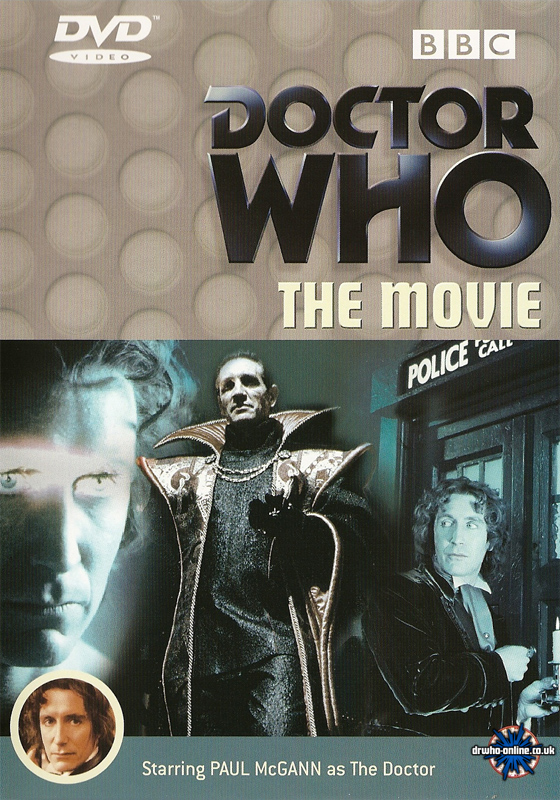
But does it really stop there? The Movie on DVD is just as lovely a
package. Crisp and clean as we should expect the picture and sound to
be, you really get a better opportunity to take in Richard Hudolin’s
magnificent sets and the dramatic, distinctive score.
Sax’s commentary is very much a technical one, and little of the actual
information he imparts will surprise you if you’ve read Regeneration,
but he still comes across as enthusiastic and personable. The on-screen
captions by Richard Molesworth are a very nice feature which do bring up
some interesting new points - locations, and most notably, the end of
each ‘Act’ as it was shown on American TV (the points where the
commercials interject.)
Segal is interviewed at length, both then and now, and is typically
frank. It’s a shame the most vociferous whingers of fandom have reduced
this guy to apologising for much of the show, and I felt a bit sorry for
him in places. I’m sure he wasn’t the reason Doctor Who was cancelled in
1989, and though we know he did away with The Dark Dimension, having
read the story outline, I for one am not shedding tears at the loss of
that calibre of unashamed fanwank, Graham Harper or no Graham Harper.
You get a nice music feature, the BBC trailers (I must have seen them at
the time but I don’t remember them) and the Fox promo, which divorced
from clippage is a fascinating insight into American TV tactics in it’s
own right if you aren’t familiar with them.
All in all, this is a superb value package for a really fine production,
and crusty detractors would do well to remember that… yes… actually…
come to think of it… there was a future! The BBC felt the need to
actively promote the series again, and the merchandise drive that
followed wasn’t just cash-cow cynicism, but a golden opportunity to
bring Who back to respectable public consciousness that actually worked.
We’ve got audio dramas now. We’ve got a radio series that’s actually got
potential. Tom bless the TV Movie - and all Who sale in her.
There’s life - and there’s hope.